Vehicle security barriers for pedestrian zones and city centres
City centres need both at once: protection from vehicles — and permeability for everyone who keeps the city running. Berlin-Cube resolves that contradiction.

Looking towards the Kaiser Wilhelm Memorial Church. Trees, lavender and perennials grow inside the modules, not beside them.
Protection and permeability are not opposites
A pedestrian zone is not a sealed space. Cycle traffic runs through, deliveries need access, the pavement must stay reachable for everyone, emergency routes must remain clear. Berlin-Cube is linked into a continuous line: drivable ramps sit between the modules, and where emergency routes must remain clear, the modules are placed in a staggered layout — protected and still passable. Access protection does not mean barricading.
Tested security as street furniture
The protection is tested — DEKRA generation 1 to IWA 14-1 N2A, EU patent EP3486374 — but none of it shows in the streetscape. What you see are trees, lavender and perennials in the modules, benches with timber tops, and a recessed light strip that marks the installation at night without floodlighting the street.
Built on Berlin's Kantstraße
Since June 2026, the first complete installation has stood on Berlin's Kantstraße, between the Waldorf Astoria and Upper West — planted, lit, walkable. The installation remains in place until the end of September 2026, when it will be dismantled as planned — set up without foundations, removed without trace. Pilot installation in cooperation with AG City Berlin and the Charlottenburg-Wilmersdorf District Office. Not a rendering: photographs taken on site.
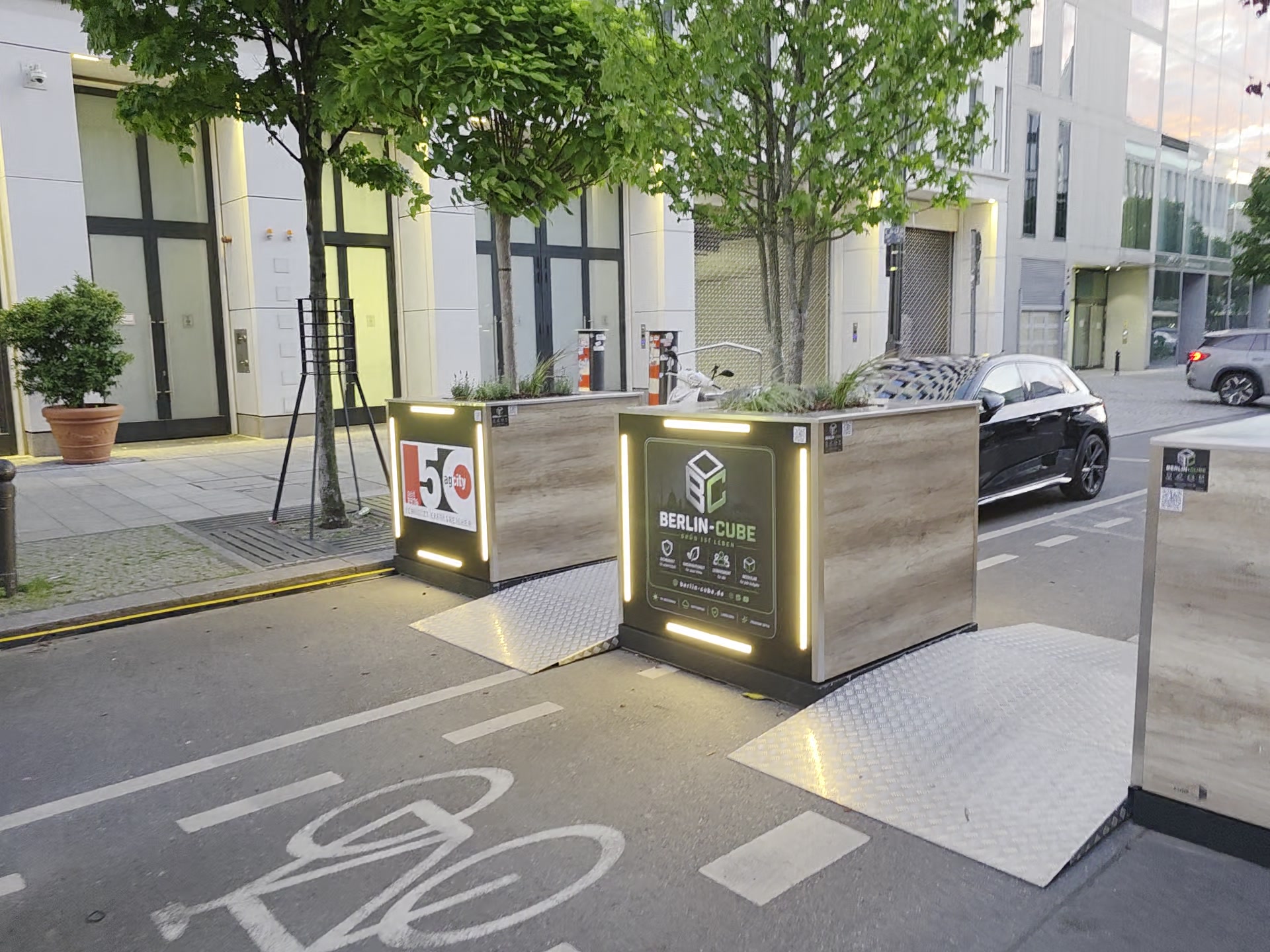
Drivable ramps sit between the modules — the route stays open for everyone.

Linked into a continuous line. Every second module carries a bench.
Frequently asked questions
How does the pedestrian zone stay permeable?
Drivable ramps sit between the modules: cycle traffic runs through, the pavement stays reachable, deliveries keep their access.
What about emergency routes?
In planning, wherever emergency routes must remain clear, the modules are placed in a staggered layout — protected and still passable.
Is the protection tested?
Yes. DEKRA generation 1 vehicle security barrier to IWA 14-1 N2A, EU patent EP3486374. The safe zone begins 7.95 metres behind the module.
How quickly can an installation be set up?
The complete built installation on Berlin's Kantstraße was set up in around ten hours — no foundations, no intervention in the surface.
Is there a built reference?
Yes. Since June 2026, the first complete installation has stood on Berlin's Kantstraße, between the Waldorf Astoria and Upper West — planted, lit, walkable. The installation remains in place until the end of September 2026, when it will be dismantled as planned — set up without foundations, removed without trace.