Vehicle access protection for cultural venues and public institutions
Protecting open places without losing their open character.
Museums, theatres, concert halls and event squares live by being inviting. A protection concept that greets visitors with concrete first works against that. Berlin-Cube protects access routes — and shows planting, benches and light on the outside.

Seat height and timber top are part of the module. A place to stay on the outside — tested vehicle protection inside.
Open places that stay open
Cultural venues and public institutions are places of encounter: forecourts, foyer zones, open stairways, parks. Vehicle access protection is increasingly part of their planning — for museums, theatres, opera houses, concert halls, cultural events, event squares, public institutions, historic sites and parks. Berlin-Cube treats this task not as cordoning off, but as design: the tested protective function sits inside the module; what is visible are trees, perennials, timber and a recessed light strip.
Heritage-compatible: no foundations, no anchors, no drilling
Historic sites, listed squares and World Heritage settings impose a condition many protection systems cannot meet: the existing fabric must not be touched. Berlin-Cube modules are placed on the existing surface — without foundations, without anchors, without drilling. When the installation is no longer needed or is to move elsewhere, it is removed without trace. In heritage and World Heritage contexts, that is precisely the decisive argument: protection that does not alter the place.
Temporary or permanent — the same modules
For an exhibition opening, a festival in the park or a theatre season, the protection can be set up temporarily and removed afterwards. For forecourts that are to be protected permanently, the modules stay — planted to last, with benches that are part of the module. Drivable ramps sit between the modules: accessibility, deliveries and emergency routes remain part of the planning.
Quiet security communication
A protection concept always sends a message. Concrete blocks and steel bollards say: danger here. Berlin-Cube says: you can stay here. For cultural venues that thrive on openness, this message is part of the brief — security you don't have to see. You experience it.
Test evidence
Berlin-Cube is tested as a DEKRA generation 1 vehicle security barrier to IWA 14-1 N2A and protected by EU patent EP3486374. The protection concept for a specific site — distances, layout, emergency routes — is developed together with those responsible.
- Testing body
- DEKRA
- Test standard
- IWA 14-1 N2A · Generation 1
- Test vehicle
- 7,114 kg at 63.9 km/h
- Safe zone
- from 7.95 m behind the module
- Patent
- EU patent EP3486374

Substrate deep enough for woody plants, not seasonal bedding. The planting is designed to stay.
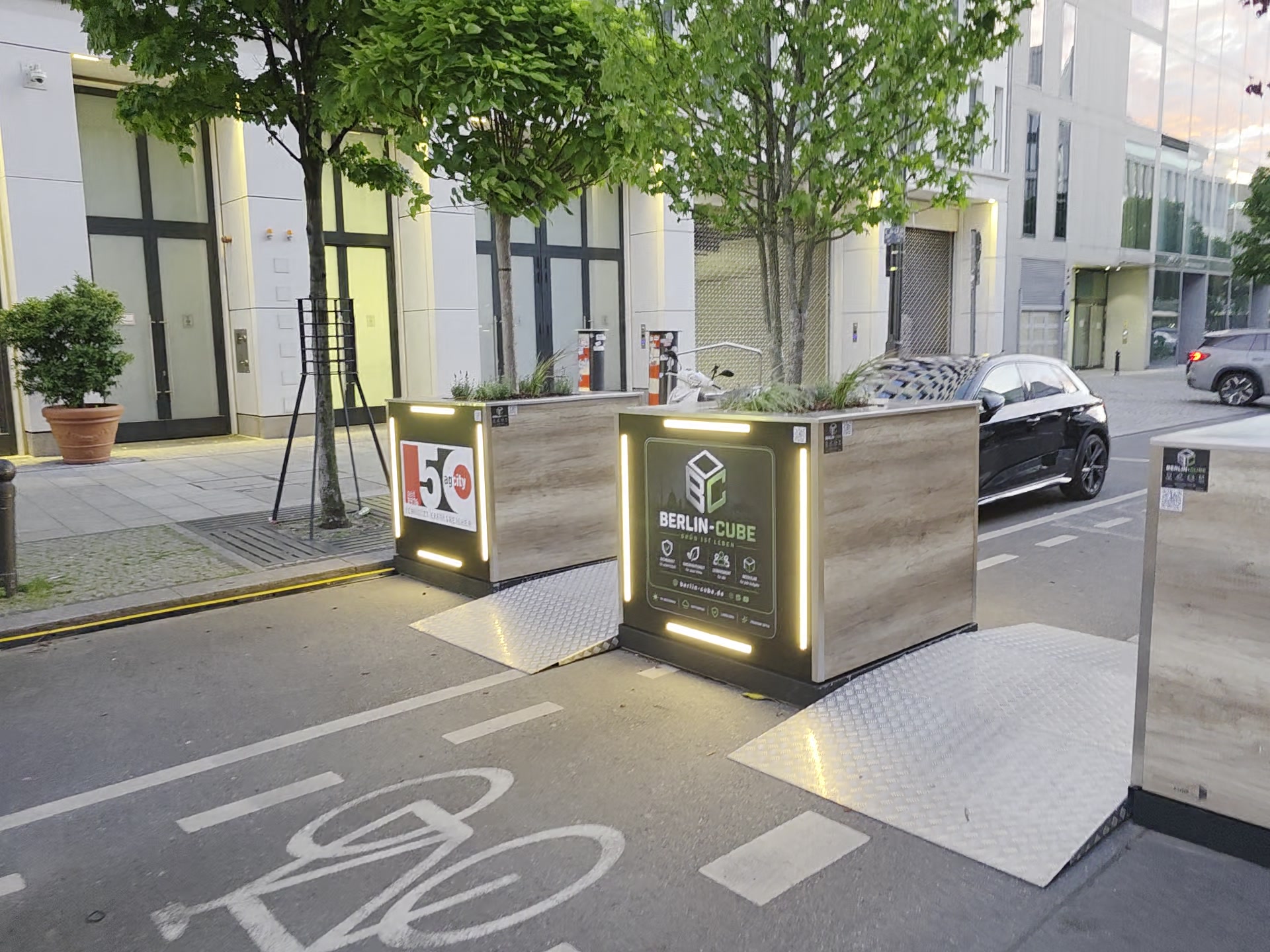
Drivable ramps sit between the modules — access, deliveries and emergency routes can be planned.
Frequently asked questions
Is Berlin-Cube suitable for listed heritage sites?
The modules are placed on the existing surface without foundations, anchors or drilling and can be removed without trace. Whether use is possible in a specific heritage context is decided by the responsible heritage authorities case by case.
Is Berlin-Cube a tested vehicle security barrier?
Yes. DEKRA generation 1 to IWA 14-1 N2A — tested with a 7,114 kg test vehicle at 63.9 km/h. The safe zone begins 7.95 metres behind the module. No tests to other standards have been carried out.
Can the protection be set up for a single event only?
Yes. The modules stand on the existing surface and are removed again after the event — without intervention in the site.
Do access, deliveries and emergency routes stay clear?
Planning provides drivable ramps between the modules; where emergency routes must remain clear, the modules are placed in a staggered layout — protected and still passable.
Where can the system be seen?
Since June 2026, the first complete installation has stood on Berlin's Kantstraße, between the Waldorf Astoria and Upper West — planted, lit, walkable. The installation remains in place until the end of September 2026, when it will be dismantled as planned — set up without foundations, removed without trace.